What would it be like to be caught between worlds?
The world of the living and the world of the dead.
The world of the living and an other world of a distant alien planet.
Both are plausible explanations of the island in LOST. It is true because of the lack of concrete canon to support the sci-fi story lines with actual physics.
Peppered throughout the discussions of the island are scientific concepts like "portals," "worm holes," time travel experimentation, psychological conditioning, and unique electromagnetic properties. But to suspend belief in a science basis for the island, what do we have to consider?
An island that cannot be seen or mapped from the sky is not an island. It is something else.
An island that can move and disappear is not an island. It has to be something else.
But since Eloise Hawking could calculate its apparent location (with some assumptions), the island's movement must follow a pattern. Nature follows patterns. So does the Earth's electromagnetic grid. The island could be moving to intersection points along with Earth's electromagnetic grid. This makes the island a ship and not an island.
Electromagnetism and bending of light are principles in research for stealth technologies. To make things appear invisible, magicians use mirrors and distraction (such as a pretty assistant) to make the illusion complete. Mirrors, distractions and illusions were all story points in LOST.
What is the purpose of an island moving along an electromagnetic grid? It could be "recharging" itself from specific deep core entry points. It may need a certain amount of energy or flow to "contain" its own power system (which malfunctioned several times to create time skips and purple skies).
Some viewers believed the island was a space-time portal. The teleportation of Locke and Ben to Tunisia was proof of it (in a small scale). The capture of Flight 815 from the sky could be another example as well as all the ship wrecks. It could also explain the "immortality" of Jacob since he controlled the island and thus controlled time itself. One could equate Jacob to that of being a Time Lord.
No one has really thought about the island as being a TARDIS like device piloted by aliens. But in a UFO observatory conspiracy theory, an island would be a good cover to house a base to spy on human beings. A remote island would be a great place to bring humans to do experiments on. You don't need to be gray aliens to poke humans; as shape shifting beings you can create yourself in the image of your laboratory animals.
Jacob and the Man in Black did admit that bringing humans to the island was part of their grand game. An experiment on how humans react to the island conditions, with MIB lamenting that humans always screwed up in the end. MIB was so frustrated with it that he wanted to go "home." But Jacob would not let him - - - basically making him/it a prisoner on the island. So MIB used the corrupt humans in order to rebel against Jacob, to seize control of the island ship to leave Earth.
It does sound like a Dr. Who story line: who controls the TARDIS can control the universe. As Widmore desired control of the island, there were others like Ben who tried to protect it from becoming a weapon of power. But Ben was corrupted by that same power when he purged Dharma.
Therefore, we have the literary means of the island being the center piece between two worlds. The debate is what is the other world? Is it the religious connotation of the after life (as adored by the temple and the Egyptian mythology)? Or it is a sci-fi based drama based upon the Faraday notebook and Dharma stations?
In either situation, it puts our castaways not as lost survivors of a transportation disaster, but human guinea pigs in a science fiction fantasy world.
Showing posts with label time. Show all posts
Showing posts with label time. Show all posts
Tuesday, March 13, 2018
Monday, July 25, 2016
CRITICAL SCIENCE
Some researchers now see popular ideas like string theory and the
multiverse as highly suspect. These physicists feel our study of the
cosmos has been taken too far from what data can constrain with the
extra "hidden" dimensions of string theory and the unobservable other
universes of the multiverse. Of course, there are many scientists who
continue to see great promise in string theory and the multiverse. But, as researchers wrote in the New York Times last year, it all adds up to muddied waters and something some researchers see as a "crisis in physics."
Some scientists believe this crisis is real — and it's acute. They pull no punches in their sense that the lack of empirical data has led the field astray. As they put it:
For example, global warming studies have sent billions of research dollars into academia. However, critics view scientists creating their own "computer models" to study the Earth's temperature defy one of science's fundamental processes: observation, recordation, interpretation, and thesis. If you start with a pre-determined scientific thesis, you work backwards in order to create a result.
If the Earth is warming, the vast majority of funded scientists claim it is man made pollution or CO2 emissions (which have to contained, regulated and taxed by the same governments funding the studies). But these studies fail the third grade smell test. Who did not learn in elementary school that the climate of our planet is determine by the solar radiation of the sun, the orbit of the Earth and tilt of its axis? None of those factors are tested in current climate studies.
And the studies send alarm bells to the general public who are not told that the Earth has had cycles of warm periods and cold periods (including ice ages). The dinosaurs that lived in tropical climates that people visit at museums were dug up in currently chilly Montana.
Another example is the daily headline that some study has found something GOOD for your health or something is BAD for your health. You have to look to the fine print to find out who funded the study. If a manufacturing or product lobbying group funded the research with a "pro" conclusion, there may be serious bias built in the result. Or if a study claims "meat" is toxic death but it was funded by a vegan environmental group, you have to take the results with a grain of salt.
Science needs critical thinking in order to make real breakthroughs.
If big pharma companies continue to poor millions in R&D to help symptoms of disease (with numerous side effects), they are not looking for a cure for the underlying disease. There are still only a handful of actual vaccines for known diseases. It is odd that with the advancement in medical technology that more cures have not been found.
Some believe that genetic and DNA manipulation are the keys to finding breakthrough medical treatments. But none of the basic childhood vaccines needed genetic testing in order to be found and manufactured for the masses.
Many of the cures were found by scientists and physicians who were looking for a solution to solve a real life problem in their practices. They were not out to make money but to make a contribution to public health. It may be a sentimental folly to ask that today's researchers shed their green colored visors to look for the greater good when there is so much money to be made in modern medicine.
Some scientists believe this crisis is real — and it's acute. They pull no punches in their sense that the lack of empirical data has led the field astray. As they put it:
Fraud in academics is not new. One of the reasons that spawns concerns is that huge government education grants target specific research which may bias independent research."Science is corrupted when it abandons the discipline of empirical validation or dis-confirmation. It is also weakened when it mistakes its assumptions for facts and its ready-made philosophy for the way things are."
For example, global warming studies have sent billions of research dollars into academia. However, critics view scientists creating their own "computer models" to study the Earth's temperature defy one of science's fundamental processes: observation, recordation, interpretation, and thesis. If you start with a pre-determined scientific thesis, you work backwards in order to create a result.
If the Earth is warming, the vast majority of funded scientists claim it is man made pollution or CO2 emissions (which have to contained, regulated and taxed by the same governments funding the studies). But these studies fail the third grade smell test. Who did not learn in elementary school that the climate of our planet is determine by the solar radiation of the sun, the orbit of the Earth and tilt of its axis? None of those factors are tested in current climate studies.
And the studies send alarm bells to the general public who are not told that the Earth has had cycles of warm periods and cold periods (including ice ages). The dinosaurs that lived in tropical climates that people visit at museums were dug up in currently chilly Montana.
Another example is the daily headline that some study has found something GOOD for your health or something is BAD for your health. You have to look to the fine print to find out who funded the study. If a manufacturing or product lobbying group funded the research with a "pro" conclusion, there may be serious bias built in the result. Or if a study claims "meat" is toxic death but it was funded by a vegan environmental group, you have to take the results with a grain of salt.
Science needs critical thinking in order to make real breakthroughs.
If big pharma companies continue to poor millions in R&D to help symptoms of disease (with numerous side effects), they are not looking for a cure for the underlying disease. There are still only a handful of actual vaccines for known diseases. It is odd that with the advancement in medical technology that more cures have not been found.
Some believe that genetic and DNA manipulation are the keys to finding breakthrough medical treatments. But none of the basic childhood vaccines needed genetic testing in order to be found and manufactured for the masses.
Many of the cures were found by scientists and physicians who were looking for a solution to solve a real life problem in their practices. They were not out to make money but to make a contribution to public health. It may be a sentimental folly to ask that today's researchers shed their green colored visors to look for the greater good when there is so much money to be made in modern medicine.

Thursday, July 7, 2016
THE FORMATIVE NUMBERS
When one connects the cross Numbers on a clock face, you get the following result:
8, 10, 12, 14, 16 and 18.
These numbers could be important because they form the basis of the formative years of a person's personal growth.
At common law, the age of 7 was deemed the age of reason. A person was expected to know the difference between right and wrong.
The age of 18 confirms adulthood. A person is emancipated from their parent's guardianship. They can join the military, make contracts, get married, etc.
How one what acts and behaves during the time between age 8 and 18 is important. What were the parental guidance? What were the environmental factors? What were the support mechanisms? Did the person learn values, goals and ethics? Did he or she fall in the wrong crowd?
Look at the people devoid of parental love and attention:
Locke.
Ben.
Sawyer (after his parents were killed).
Look at people who only had the attention of one parent:
Hurley.
Kate.
Shannon.
Walt.
Claire.
Jin.
Look at people who had a "normal" upbringing:
Jack.
Sun.
Sayid.
In the "normal" group, Jack had the upper middle class upbringing which led him to become a highly respected surgeon. He was smart, encouraged, had the means and opportunity to get a large slice of the American Dream. But in the end, was he a happy person?
Sun came from a very wealthy family. She was repressed by class status and her Korean culture. The only way she could get attention and feel independent was to rebel against her father in the worst possible way: by marrying a poor man. But even that goal did not make her a happy person.
Sayid grew up in a tight family setting in Iraq. His household was ruled by a strict father and a demanding culture. Sayid did what he had to do - - - such as butchering an animal his older brother could not do - - - which gave himself value to the group. And that need to be valuable in a group was the anchor that dragged his personal ambition and happiness down.
In many ways, the characters brought up by one parent have two common traits: loneliness and selfishness. Hurley was raised by his strict mother after his father left. She was religious and pushy, especially about his social life. That caused Hurley to eat to repress his social life. As a result, his mother enabled him to become a shy, quiet, dependent child who would never want to leave the artificial womb of her home. It is selfish to stay with a parent when, with any personal drive, you should be on your own. Claire had a similar relationship with her mother. Her mother wanted her to settle on a normal path, but Claire had a wild streak. They would fight over trivial matters. The last argument led to her mother's severe and fatal injuries.
You can add bitterness to characters like Kate and Walt. They were given a relatively carefree life, their needs being met by their mothers, but they were not very grateful. Each would act up in a controlled tantrum for attention. Then they were upset when things did not go their way, not understanding that it is the effort you have to put in yourself to get the result you want.
The characters who lost their parents early in the childhood, Ben, Locke and Sawyer, all had one driving trait: criminality. Their moral compasses did not have the bearings that parents instill in their children. Ben was beaten down daily by his alcoholic father who blamed Ben for his own shortcomings and lousy life. Locke's known abandonment was reinforced like a knife blade in his back each day he was in a foster home. Sawyer could only think of revenge after his father committed murder-suicide because of a con-man's trick on the family. Each would cross paths in the criminal world and go with its flow, including Locke - - - in seeking a "family" would have been fine living in a drug selling commune if they would accept him.
They say there is good and bad in everyone. What dominates a person's adulthood comes from what happens when a child is 8 to 18 years old. Each of LOST's main characters personalities were crystallized by events that happened in their childhoods.
8, 10, 12, 14, 16 and 18.
These numbers could be important because they form the basis of the formative years of a person's personal growth.
At common law, the age of 7 was deemed the age of reason. A person was expected to know the difference between right and wrong.
The age of 18 confirms adulthood. A person is emancipated from their parent's guardianship. They can join the military, make contracts, get married, etc.
How one what acts and behaves during the time between age 8 and 18 is important. What were the parental guidance? What were the environmental factors? What were the support mechanisms? Did the person learn values, goals and ethics? Did he or she fall in the wrong crowd?
Look at the people devoid of parental love and attention:
Locke.
Ben.
Sawyer (after his parents were killed).
Look at people who only had the attention of one parent:
Hurley.
Kate.
Shannon.
Walt.
Claire.
Jin.
Look at people who had a "normal" upbringing:
Jack.
Sun.
Sayid.
In the "normal" group, Jack had the upper middle class upbringing which led him to become a highly respected surgeon. He was smart, encouraged, had the means and opportunity to get a large slice of the American Dream. But in the end, was he a happy person?
Sun came from a very wealthy family. She was repressed by class status and her Korean culture. The only way she could get attention and feel independent was to rebel against her father in the worst possible way: by marrying a poor man. But even that goal did not make her a happy person.
Sayid grew up in a tight family setting in Iraq. His household was ruled by a strict father and a demanding culture. Sayid did what he had to do - - - such as butchering an animal his older brother could not do - - - which gave himself value to the group. And that need to be valuable in a group was the anchor that dragged his personal ambition and happiness down.
In many ways, the characters brought up by one parent have two common traits: loneliness and selfishness. Hurley was raised by his strict mother after his father left. She was religious and pushy, especially about his social life. That caused Hurley to eat to repress his social life. As a result, his mother enabled him to become a shy, quiet, dependent child who would never want to leave the artificial womb of her home. It is selfish to stay with a parent when, with any personal drive, you should be on your own. Claire had a similar relationship with her mother. Her mother wanted her to settle on a normal path, but Claire had a wild streak. They would fight over trivial matters. The last argument led to her mother's severe and fatal injuries.
You can add bitterness to characters like Kate and Walt. They were given a relatively carefree life, their needs being met by their mothers, but they were not very grateful. Each would act up in a controlled tantrum for attention. Then they were upset when things did not go their way, not understanding that it is the effort you have to put in yourself to get the result you want.
The characters who lost their parents early in the childhood, Ben, Locke and Sawyer, all had one driving trait: criminality. Their moral compasses did not have the bearings that parents instill in their children. Ben was beaten down daily by his alcoholic father who blamed Ben for his own shortcomings and lousy life. Locke's known abandonment was reinforced like a knife blade in his back each day he was in a foster home. Sawyer could only think of revenge after his father committed murder-suicide because of a con-man's trick on the family. Each would cross paths in the criminal world and go with its flow, including Locke - - - in seeking a "family" would have been fine living in a drug selling commune if they would accept him.
They say there is good and bad in everyone. What dominates a person's adulthood comes from what happens when a child is 8 to 18 years old. Each of LOST's main characters personalities were crystallized by events that happened in their childhoods.
Monday, July 4, 2016
MAKING WAVES
For the second time this year, scientists have found evidence of gravitational waves.
Gravitational waves are ripples in the curvature of spacetime that propagate as waves. generated in certain gravitational interactions and traveling outward from their source. The possibility of gravitational waves was discussed in 1893 by Heaviside using the analogy between the inverse-square law in gravitation and electricity.
Albert Einstein based his theory of general relativity on gravitational waves transporting energy as gravitational radiation. In his theory , gravity is treated as a phenomenon resulting from the curvature of spacetime. This curvature is caused by the presence of mass. Generally, the more mass that is contained within a given volume of space, the greater the curvature of spacetime will be at the boundary of its volume. As objects with mass move around in spacetime, the curvature changes to reflect the changed locations of those objects. In certain circumstances, accelerating objects generate changes in this curvature, which propagate outwards at the speed of light in a wave-like manner. These propagating phenomena are known as gravitational waves.
Gravitational waves cannot exist in the Newtonian theory of gravitation since Newtonian theory postulates that physical interactions propagate at infinite speed.
Astronomers which aims to use gravitational waves to collect observational data about objects such as neutron stars and black holes to supernova events to help explain the universe and the Big Bang Theory.
Understanding these concepts is important in figuring out if humans can leave Earth to make deep space explorations. In science fiction writings, the universe is so large it is impossible to travel long distances during a normal human life time. By bending the known rules, writers have given the prospect of space travel by bending time and space ("warp drive") to bounce around the vastness of space like driving cross country with an Interstate Highway map.
This adds to the discussion of whether time itself is linear. We currently perceive time as linear because our calendars and clocks march forward along a single line of seconds, minutes, hours, days, weeks, months and years. But ancient people did not see time as linear, but as a cycle of spring, summer, fall and winter as based upon the rotation of objects in the sky.
For a space traveler, the concept of time and distance is important. The universe is expanding which means there are great forces pushing everything outward. It is up to us to figure out how to tap this unseen and unknown force to break the known boundaries of physics.
In physics, Acceleration is the rate of change of velocity of an object. An object's acceleration is the net result of any and all forces acting on the object, as described by Newton's Second Law. The second law states that the rate of change of momentum of a body, is directly proportional to the force applied and this change in momentum takes place in the direction of the applied force.
If gravitational waves are forces that ripple across the universe, those forces can be used to help propel objects in space. For example, if one is in the ocean, waves created by the force of currents, push any surface objects toward the shoreline at variable speeds depending upon atmospheric conditions (such as wind velocity). A surfer rides the wave at the same speed of the wave. But if the surfer adds to his own speed (such as adding a wind sail or a power prop to the board), he could go faster than the actual wave he is riding.
In theory, if one can ride a gravitational wave in space, you can use it to propel your rocket faster because you are adding more applied force than the rocket produces on its own. And if gravitational waves are moving at light speed, then adding any additional force to it could mean you can propel an object at greater than light speed (the key to interstellar travel).
Scientists wonder if black holes, star degradation or supernova events that expel mass into the universe have some corresponding effect on gravity and other unknown elements in space (such as dark matter or dark energy).
When Daniel arrived on the island, he noticed that the light acted differently and time did not sync with the freighter several miles off shore. The light may have had a ripple effect such as to disclose that the island was riding a gravitational wave away from the ship. This anomaly in nature could have been a great power source or portal across the spacetime universe. And that was the reason why Widmore and Linus were fighting for its control.
What was under the Hatch could have been a complex tied to the island's electromagnetic energy that could have created gravitational waves since the island itself was accelerating away from known objects in the same ocean space. The ripple in spacetime by using gravitational waves would phase the island out-of-sync with normal objects - - - in a way to make the island disappear because its gravity and mass would be different than Earth's. If true, the ramifications would have changed how man would fight future wars or explore space.
Gravitational waves are ripples in the curvature of spacetime that propagate as waves. generated in certain gravitational interactions and traveling outward from their source. The possibility of gravitational waves was discussed in 1893 by Heaviside using the analogy between the inverse-square law in gravitation and electricity.
Albert Einstein based his theory of general relativity on gravitational waves transporting energy as gravitational radiation. In his theory , gravity is treated as a phenomenon resulting from the curvature of spacetime. This curvature is caused by the presence of mass. Generally, the more mass that is contained within a given volume of space, the greater the curvature of spacetime will be at the boundary of its volume. As objects with mass move around in spacetime, the curvature changes to reflect the changed locations of those objects. In certain circumstances, accelerating objects generate changes in this curvature, which propagate outwards at the speed of light in a wave-like manner. These propagating phenomena are known as gravitational waves.
Gravitational waves cannot exist in the Newtonian theory of gravitation since Newtonian theory postulates that physical interactions propagate at infinite speed.
Astronomers which aims to use gravitational waves to collect observational data about objects such as neutron stars and black holes to supernova events to help explain the universe and the Big Bang Theory.
Understanding these concepts is important in figuring out if humans can leave Earth to make deep space explorations. In science fiction writings, the universe is so large it is impossible to travel long distances during a normal human life time. By bending the known rules, writers have given the prospect of space travel by bending time and space ("warp drive") to bounce around the vastness of space like driving cross country with an Interstate Highway map.
This adds to the discussion of whether time itself is linear. We currently perceive time as linear because our calendars and clocks march forward along a single line of seconds, minutes, hours, days, weeks, months and years. But ancient people did not see time as linear, but as a cycle of spring, summer, fall and winter as based upon the rotation of objects in the sky.
For a space traveler, the concept of time and distance is important. The universe is expanding which means there are great forces pushing everything outward. It is up to us to figure out how to tap this unseen and unknown force to break the known boundaries of physics.
In physics, Acceleration is the rate of change of velocity of an object. An object's acceleration is the net result of any and all forces acting on the object, as described by Newton's Second Law. The second law states that the rate of change of momentum of a body, is directly proportional to the force applied and this change in momentum takes place in the direction of the applied force.
If gravitational waves are forces that ripple across the universe, those forces can be used to help propel objects in space. For example, if one is in the ocean, waves created by the force of currents, push any surface objects toward the shoreline at variable speeds depending upon atmospheric conditions (such as wind velocity). A surfer rides the wave at the same speed of the wave. But if the surfer adds to his own speed (such as adding a wind sail or a power prop to the board), he could go faster than the actual wave he is riding.
In theory, if one can ride a gravitational wave in space, you can use it to propel your rocket faster because you are adding more applied force than the rocket produces on its own. And if gravitational waves are moving at light speed, then adding any additional force to it could mean you can propel an object at greater than light speed (the key to interstellar travel).
Scientists wonder if black holes, star degradation or supernova events that expel mass into the universe have some corresponding effect on gravity and other unknown elements in space (such as dark matter or dark energy).
When Daniel arrived on the island, he noticed that the light acted differently and time did not sync with the freighter several miles off shore. The light may have had a ripple effect such as to disclose that the island was riding a gravitational wave away from the ship. This anomaly in nature could have been a great power source or portal across the spacetime universe. And that was the reason why Widmore and Linus were fighting for its control.
What was under the Hatch could have been a complex tied to the island's electromagnetic energy that could have created gravitational waves since the island itself was accelerating away from known objects in the same ocean space. The ripple in spacetime by using gravitational waves would phase the island out-of-sync with normal objects - - - in a way to make the island disappear because its gravity and mass would be different than Earth's. If true, the ramifications would have changed how man would fight future wars or explore space.
Saturday, June 18, 2016
DIFFERENTIAL TIME
Scientists are perplexed by the fact that our Milky Way galaxy is traveling significantly faster than the two adjacent galaxies. Under the Big Bang Theory, all matter should be traveling away from the initial core at the same velocity. However, there is something at work that makes our galaxy behave differently. Some call the unknown mechanism "the Great Attractor," pulling us faster than our neighbors.
Some speculate that it may be a concentration of dark matter or dark energy that is the force that is moving galaxies around like ping pong balls in a steady breeze. Others think it may have to do with gravitational pulls from unknown objects or forces that create gravity itself.
If we know that our system is traveling faster in space, thence faster in space-time, than another galaxy, that would mean that travel in space (and the time to travel in space) is not universally linear.
It is one of those wordy math problems about two trains leaving the station at the same time, but traveling at different speeds but having different stops. Which trains arrives at the end station first?
But this has a place in LOST lore. Daniel's time-rocket experiments from the freighter to the island showed that the island was moving away from the ship. Which was a problem for a stationary island. If island time, and Daniel observed the light being "different," was moving at a different rate than the rest of Earth, we have the same problem as scientists have with the Milky Way issue.
The localized time difference led to theories about the island being an anomaly. It was either a space-time portal, or on event horizon of a stable micro-black hole. It was also thought as an interdimensional bridge between universes.
If there are parallel universes, what type of matter would be between its layers? Is this the area where dark matter resides? Does the parallel universes masses have gravitational pulls through the separation zones into our own universe (thus explaining the speed differences between galaxies)?
If you look at Earth itself, its crust sits mostly stationary on the surface while tectonic plates are moved about through the pressure and movement of the hot magma at the planet's core. If our universe sits on the crust of known space, the parallel universe's forces could be equated with the subsurface geologic properties which have a direct effect on the surface plates.
If the Milky Way is traveling at 2.2 million km/hour in space, why do we feel time is a slow 60 minutes in an hour? Our perception of time comes from the solar cycle of the sun around our planet. We do not feel or sense that we are moving at speeds 2,500 times faster than a jet airliner because everything around us is traveling at the same relative speed. We only become aware of the differences in relative speed when something is slower or faster than our current position. When one is jogging at 1 mile/10 minutes and a bird flies by and zooms off into the distance, we know that the bird is traveling faster than we are at that moment. But if we are traveling 55 mph in a car and we overtake a bird flying down the road, we know that we are traveling faster than that creature.
The same must hold true in space. The Milky Way is the car and the neighboring galaxies are the birds being left behind in our wake.
But this opens up a practical question. If our galaxy is moving away faster from adjoining galaxies, would it not take more force, effort and time to move against the forces that is driving us a part? It would be swimming against a strong current.
If Einstein was correct and the speed of light is the fastest anything can go in space, would someone traveling to our galaxy make it quicker to us then us trying to travel to them?
And when would arrive at a place that is traveling slower in space time, would we have aged slower or become younger? It is an odd tangent that space travel could be the real "Fountain of Youth." Aging is a measure of the passage of time. But what happens when one reverses the process of time in the aging process? Do you become immortal? Is it like Eloise Hawking - - - or Bill Murray in Groundhog Day - - - being alive long enough to know everything?
But as NASA scientists have said, any trips to Mars would essentially be one-way missions. The amount of fuel to propel a massive space craft with supplies to set up living quarters on Mars would be prohibitive of a return trip. But even against that death sentence, thousands of people signed up for a private colonization of Mars. Why? Because they must believe their time on Earth is finite and uneventful while a trip to Mars would be immortal history of space exploration.
Did the LOST characters stumble upon a remnant of ancient space exploration disguised as the island? Perhaps. Nothing is outside the realm of possibility when it came to the divergent streams of show plot and story lines.
Some speculate that it may be a concentration of dark matter or dark energy that is the force that is moving galaxies around like ping pong balls in a steady breeze. Others think it may have to do with gravitational pulls from unknown objects or forces that create gravity itself.
If we know that our system is traveling faster in space, thence faster in space-time, than another galaxy, that would mean that travel in space (and the time to travel in space) is not universally linear.
It is one of those wordy math problems about two trains leaving the station at the same time, but traveling at different speeds but having different stops. Which trains arrives at the end station first?
But this has a place in LOST lore. Daniel's time-rocket experiments from the freighter to the island showed that the island was moving away from the ship. Which was a problem for a stationary island. If island time, and Daniel observed the light being "different," was moving at a different rate than the rest of Earth, we have the same problem as scientists have with the Milky Way issue.
The localized time difference led to theories about the island being an anomaly. It was either a space-time portal, or on event horizon of a stable micro-black hole. It was also thought as an interdimensional bridge between universes.
If there are parallel universes, what type of matter would be between its layers? Is this the area where dark matter resides? Does the parallel universes masses have gravitational pulls through the separation zones into our own universe (thus explaining the speed differences between galaxies)?
If you look at Earth itself, its crust sits mostly stationary on the surface while tectonic plates are moved about through the pressure and movement of the hot magma at the planet's core. If our universe sits on the crust of known space, the parallel universe's forces could be equated with the subsurface geologic properties which have a direct effect on the surface plates.
If the Milky Way is traveling at 2.2 million km/hour in space, why do we feel time is a slow 60 minutes in an hour? Our perception of time comes from the solar cycle of the sun around our planet. We do not feel or sense that we are moving at speeds 2,500 times faster than a jet airliner because everything around us is traveling at the same relative speed. We only become aware of the differences in relative speed when something is slower or faster than our current position. When one is jogging at 1 mile/10 minutes and a bird flies by and zooms off into the distance, we know that the bird is traveling faster than we are at that moment. But if we are traveling 55 mph in a car and we overtake a bird flying down the road, we know that we are traveling faster than that creature.
The same must hold true in space. The Milky Way is the car and the neighboring galaxies are the birds being left behind in our wake.
But this opens up a practical question. If our galaxy is moving away faster from adjoining galaxies, would it not take more force, effort and time to move against the forces that is driving us a part? It would be swimming against a strong current.
If Einstein was correct and the speed of light is the fastest anything can go in space, would someone traveling to our galaxy make it quicker to us then us trying to travel to them?
And when would arrive at a place that is traveling slower in space time, would we have aged slower or become younger? It is an odd tangent that space travel could be the real "Fountain of Youth." Aging is a measure of the passage of time. But what happens when one reverses the process of time in the aging process? Do you become immortal? Is it like Eloise Hawking - - - or Bill Murray in Groundhog Day - - - being alive long enough to know everything?
But as NASA scientists have said, any trips to Mars would essentially be one-way missions. The amount of fuel to propel a massive space craft with supplies to set up living quarters on Mars would be prohibitive of a return trip. But even against that death sentence, thousands of people signed up for a private colonization of Mars. Why? Because they must believe their time on Earth is finite and uneventful while a trip to Mars would be immortal history of space exploration.
Did the LOST characters stumble upon a remnant of ancient space exploration disguised as the island? Perhaps. Nothing is outside the realm of possibility when it came to the divergent streams of show plot and story lines.
Thursday, June 9, 2016
WARPING SPACE-TIME
One of the mysteries of the island was its ability to shift in time and space.
On June 30th, 1905, Albert Einstein started a revolution with the publication of theory of Special Relativity. This theory, among other things, stated that the speed of light in a vacuum is the same for all observers, regardless of the source. In 1915, he followed this up with the publication of his theory of General Relativity, which asserted that gravity has a warping effect on space-time. For over a century, these theories have been an essential tool in astrophysics, explaining the behavior of the Universe on the large scale.
However, since the 1990s, astronomers have been aware of the fact that the Universe is expanding at an accelerated rate. In an effort to explain the mechanics behind this, suggestions have ranged from the possible existence of an invisible Dark Energy to the possibility that Einstein’s field equations of General Relativity.
As published in Universe Today, scientists from Japan using the Fiber Multi-Object Spectrograph (FMOS) on the Subaru Telescope created the deepest 3-D map of the Universe to date. All told, this map contains some 3,000 galaxies and encompasses a volume of space measuring 13 billion light-years.
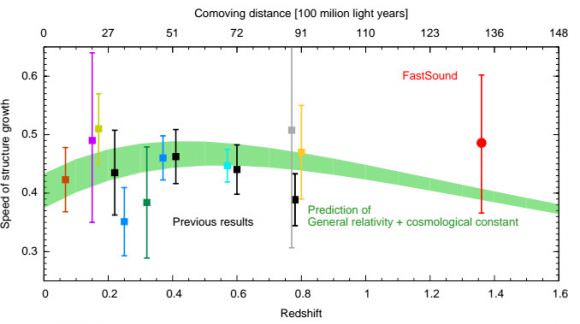
As part of their effort to ascertain the
origins of cosmic acceleration, this project relies on data collected by
the Subaru telescope to create a survey that monitors the redshift of
galaxies. The expansion of the universe has been accelerating since the universe entered its dark energy era, at redshift z≈0.4 (roughly 5 billion years ago). Within the framework of Einstein's general relativity, an accelerating expansion can be accounted for by a positive value of the cosmological constant.
If gravity can warp space-time in a way to show that the universe is expanding at an accelerated pace, then this can be the sci-fi basis for the island's time and space shifts. It would also mean that the frozen donkey wheel tie in to the island's unique electromagnetic energy could be complex or wrong. The Hatch was the station that kept the EM energy levels in check. It was the FDW that was turned to created a different result: time teleportation of matter (abet, selective matter and people which is a real continuity problem). If the island EM was intersecting a universal stream of dark energy gravity, that could explain why the island acted beyond the normal boundaries of Earth's physics. This intersection of two different properties could lead to the creation of micro-universes within the present universe. This warping of space-time at a localized level would have been of great value to the scientific, military and industrial world.
On June 30th, 1905, Albert Einstein started a revolution with the publication of theory of Special Relativity. This theory, among other things, stated that the speed of light in a vacuum is the same for all observers, regardless of the source. In 1915, he followed this up with the publication of his theory of General Relativity, which asserted that gravity has a warping effect on space-time. For over a century, these theories have been an essential tool in astrophysics, explaining the behavior of the Universe on the large scale.
However, since the 1990s, astronomers have been aware of the fact that the Universe is expanding at an accelerated rate. In an effort to explain the mechanics behind this, suggestions have ranged from the possible existence of an invisible Dark Energy to the possibility that Einstein’s field equations of General Relativity.
As published in Universe Today, scientists from Japan using the Fiber Multi-Object Spectrograph (FMOS) on the Subaru Telescope created the deepest 3-D map of the Universe to date. All told, this map contains some 3,000 galaxies and encompasses a volume of space measuring 13 billion light-years.
Experimental
results looking at the expansion of the universe, in comparison to that
predicted by Einstein’s theory of general relativity in green. Credit:
Kavli IPMU/Okumura et al.
If gravity can warp space-time in a way to show that the universe is expanding at an accelerated pace, then this can be the sci-fi basis for the island's time and space shifts. It would also mean that the frozen donkey wheel tie in to the island's unique electromagnetic energy could be complex or wrong. The Hatch was the station that kept the EM energy levels in check. It was the FDW that was turned to created a different result: time teleportation of matter (abet, selective matter and people which is a real continuity problem). If the island EM was intersecting a universal stream of dark energy gravity, that could explain why the island acted beyond the normal boundaries of Earth's physics. This intersection of two different properties could lead to the creation of micro-universes within the present universe. This warping of space-time at a localized level would have been of great value to the scientific, military and industrial world.
Wednesday, May 18, 2016
12
In order to probe for more meaning in the Series, this post postulates working the Numbers in order to see if something falls from the creative tree.
The Numbers: 4, 8, 15, 16, 23, 42.
The Numbers were the winning picks for Hurley's cursed lottery ticket.
The Numbers were the SOS signal that Hurley's mental patient friend heard in the Pacific.
The Numbers were assigned by Jacob to his candidates.
The Numbers were used to control the electromagnetic discharge.
One of the themes of the show was time. Time was an important plot and action device to move characters into twisting situations.
Time is best represented by a clock face.
 If the Numbers were the first part of a code, then using clock face we can try to find hidden information. If we start at 4 then add 8 we get to 12 (circled). If we add the next Number, 15, and count through the dial we land, we land at 3 (circled). If we continue this addition around the clock we land on 6, 7 and 12 again.
If the Numbers now lead us to another set of numbers (as codes often do), what does 3, 6, 7 and 12 represent?
If we go to the lighthouse candidate dial, there begins some speculative answers.
The Number 3 does not appear in the records. Neither does Number 6 or 7. If we use this set to represent people, the first thing that came to mind was the island's first "known" family. The Number 3 could represent "Crazy Mother." Numbers 6 and 7 could represent Jacob and his brother who were born on the island. Crazy Mother killed their Roman mother in order to have company and a successor for her island guardianship.
But then who is 12?
In the lighthouse dial, the name FOSTER appears, struck out.
There was no known character with the surname Foster in the series.
But since this code has 12 doubled in occurrences, 12 must have important significance.
The word "foster" means to encourage, promote, nourish. It comes from the English word for feed, nourish. It also has a reference to "bring up another" as in being a foster parent or guardian. In English surname ancestry, the name Foster means forester, or forest ranger, a person in charge of the hunting territories.
One can make the supposition that the Number 12 represents a guardian, and in the context of the island, the island's natural guardian. It is possible that Crazy Mother was the third successor island guardian, and Numbers 4 and 5 could have been Jacob's parents who were killed prior to assuming the office or title.
Foster does impact on Jacob's childhood. Crazy Mother was actually his foster mother, not his birth mother. She raised him to become the island's new guardian. This fostering for an orphan or an abandoned child is the centerpiece of Locke's back story.
In the episode, "Cabin Fever," Locke's story starts with his mother, Emily, going out to see that older man, Cooper. Against her mother's wishes, Emily storms out to meet her boyfriend, but she is struck by an automobile. She is rushed to the the rural hospital where it is found that she is pregnant. Against all odds and 1950s medical technology, her child, Locke, is born premature. Witnessing the miracle baby from the observation window is Richard Alpert. Alpert would return to visit Locke as a child, giving him the object test to determine his character for island leadership. Locke apparently picks the wrong item, and Alpert leaves disappointed in Locke's choice.
By this time, Locke has bounced around between foster homes. In his current situation, his foster sister, Melissa, does not like him. She disrupts his board game pieces. Locke is very unhappy with his situation. But when his foster sister Jeannie dies, a golden retriever appears at the house then takes residence in Jeannie's room. Locke sees the dog as a person, the spirit of Jeannie. Once Jeannie's mother passes, the dog vanishes.
Dogs play important roles in modern society. Dogs show unconditional love, support and companionship to human beings. Dogs provide protection and comfort to people. Dogs help people, especially young children, caring, nourishment, responsibility and play.
Dogs are also powerful symbols.
In some ancient civilizations the Dog was a symbol of the underworld. In Egypt, the guardian of the dead was Anubis who was a dog-headed god. The jackal portrayed as black was the symbol of both death and regeneration.
The Dog’s quality made it associated to a guardian and therefore the protector of souls that entered the underworld. Its ability see well in the dark makes it a symbol of instinctive knowledge and the Greeks, North American Indians and Romans were said to associate Anubis with a star (Sirius) and called it a dog star.
Additionally, in ancient Mexico, the dog was buried with human sacrifice so that it could guide it to the hereafter while in ancient Scottish legend the green dog of the fairy world was believed to drive nursing mothers into the hills so as to provide milk for the fairy creatures.
It is important to connect the massive amount of ancient Egyptian symbolism in the LOST mythology. Many believe that the time and resources to create these backgrounds, symbols and messages were important background clues to the island mysteries and the overall series premise.
And what did Crazy Mother tell Jacob about the light cave? It was the source for life, death, and re-birth. Anubis, the dog god of ancient Egypt was the symbol of death and regeneration (or rebirth). These stories fit perfectly like adjacent puzzle pieces.
The Number 12 must represent Anubis, as the guardian of life, death, the protector of souls, and the underworld's agent of regeneration in the after life. As the guardian of the underworld, this means that the island is a portal or intermediate stage along the journey from life, death and rebirth. That is why Crazy Mother and Jacob sought to protect it from outsiders like Widmore who had evil intentions.
As a way station between the living and the dead, it does not mean the main characters were "dead" on the island - - - they may have been caught between the two worlds. A person's candidacy to immortality ends with their death; but to become the guardian, one needs to "accept their death" in order to be reborn. This could be what the series creators were asking in their big questions: what is life? what is death?
To assume such a powerful and important role, a viable candidate would need the compelling traits of a dog: loyalty, faithful, honest, willing to fight injustice, protect others, be vigilant, and nourish other people. The two successor guardians, Jack and Hurley, had those qualities.
The island guardians may be the gatekeepers, like the ferrymen on the River Styx, and not actually the heir to Anubis' throne. The island ordeals may have been the tests of who was worthy of the role of helping others in their journey to the next level of existence.
And this makes more sense when you realize that the last character "to awaken" to take the next step was Jack. On the island, he was the leader who rallied the survivors into a community. He continues to put himself behind the needs of other people. He helped, counseled, treated and risked his own life for them. In the sideways world, he was the last person in the church to realize what had happened to them. That they were now dead and ready for the next stage. His friends in the church greeted him warmly. Jack sat in the first pew, almost in a daze that "the most important people" in his life created the ending so they could stay together, forever.
And this parallels Jack's final moments on the island. For it is Walt's dog, Vincent, who comes from the jungle to lie next to Jack. Recall, it was Vincent who first awoke Jack after Flight 815 crashed on the island. It was Vincent's interaction with Jack that set Jack on the path to the beach, and into the chaos of helping all of the survivors - - - without any judgment.
Some may doubt the importance of Vincent as a character. Vincent was in the jungle, he heard a whistle from Christian Shephard, who we would learn was the human manifestation of the smoke monster. We presume that there were two smoke monsters on the island: Jacob and MIB as being the two immortal beings. It called Vincent over and told him to go wake up "his son." That is not a true statement, unless you use it in the context of being a foster parent. As Vincent ran off towards Jack to do this, Christian stated that Jack "had work to do." One could use those statements to indicate that this Christian form was in fact Jacob, who brought "his candidates" to the island to play a game with MIB.
But that opens the possibility that Vincent was the manifestation of MIB, taking the command from Jacob to start a "new" game. But there is a more plausible explanation - - - that Vincent was not MIB but a higher power in disguise. A higher power more important than Jacob, in a role that would not shine any light of suspicion or concern on the island hierarchy.
The final link in this decoding of the Numbers shows that Vincent is Anubis. Vincent found Jack in the bamboo clearing and led him to his flock of lost souls. In turn, it was Jack who guided the decisions for the survivors to find salvation. Vincent was present to observe all of the island tests. In a quiet way, Vincent also helped push the characters into finding clues or messages when he would "get lost" and search parties had to go and find him. It was in these searches that the characters began to bond which would be an important factor in facing the long journey and island trials. What better way to get people to do what they need to do by nudging them along instead of commanding them to so something?
And the symbolism of new numbers embodies the qualities of the family unit: mother, father, children. Parents are present to foster, nourish and develop their children into good human beings. Children are present to explore a new world, challenge it, learn about it, find their values and principles, to create purpose and understanding to their lives . . . . then repeat the process of creation.
Anubis creates new family units for the island over the eons on time. As society has developed from small tribes of hunter-gatherers into modern technology advanced families, Anubis recognizes and supports the concept of "foster" families to help lost souls find deep and meaningful relationships in life. And his foster families can include misfits, outcasts, cripples, criminals, the mentally weak, lonely and rebellious. . . the main characters on the show.
The Numbers: 4, 8, 15, 16, 23, 42.
The Numbers were the winning picks for Hurley's cursed lottery ticket.
The Numbers were the SOS signal that Hurley's mental patient friend heard in the Pacific.
The Numbers were assigned by Jacob to his candidates.
The Numbers were used to control the electromagnetic discharge.
One of the themes of the show was time. Time was an important plot and action device to move characters into twisting situations.
Time is best represented by a clock face.

If the Numbers now lead us to another set of numbers (as codes often do), what does 3, 6, 7 and 12 represent?
If we go to the lighthouse candidate dial, there begins some speculative answers.
The Number 3 does not appear in the records. Neither does Number 6 or 7. If we use this set to represent people, the first thing that came to mind was the island's first "known" family. The Number 3 could represent "Crazy Mother." Numbers 6 and 7 could represent Jacob and his brother who were born on the island. Crazy Mother killed their Roman mother in order to have company and a successor for her island guardianship.
But then who is 12?
In the lighthouse dial, the name FOSTER appears, struck out.
There was no known character with the surname Foster in the series.
But since this code has 12 doubled in occurrences, 12 must have important significance.
The word "foster" means to encourage, promote, nourish. It comes from the English word for feed, nourish. It also has a reference to "bring up another" as in being a foster parent or guardian. In English surname ancestry, the name Foster means forester, or forest ranger, a person in charge of the hunting territories.
One can make the supposition that the Number 12 represents a guardian, and in the context of the island, the island's natural guardian. It is possible that Crazy Mother was the third successor island guardian, and Numbers 4 and 5 could have been Jacob's parents who were killed prior to assuming the office or title.
Foster does impact on Jacob's childhood. Crazy Mother was actually his foster mother, not his birth mother. She raised him to become the island's new guardian. This fostering for an orphan or an abandoned child is the centerpiece of Locke's back story.
In the episode, "Cabin Fever," Locke's story starts with his mother, Emily, going out to see that older man, Cooper. Against her mother's wishes, Emily storms out to meet her boyfriend, but she is struck by an automobile. She is rushed to the the rural hospital where it is found that she is pregnant. Against all odds and 1950s medical technology, her child, Locke, is born premature. Witnessing the miracle baby from the observation window is Richard Alpert. Alpert would return to visit Locke as a child, giving him the object test to determine his character for island leadership. Locke apparently picks the wrong item, and Alpert leaves disappointed in Locke's choice.
By this time, Locke has bounced around between foster homes. In his current situation, his foster sister, Melissa, does not like him. She disrupts his board game pieces. Locke is very unhappy with his situation. But when his foster sister Jeannie dies, a golden retriever appears at the house then takes residence in Jeannie's room. Locke sees the dog as a person, the spirit of Jeannie. Once Jeannie's mother passes, the dog vanishes.
Dogs play important roles in modern society. Dogs show unconditional love, support and companionship to human beings. Dogs provide protection and comfort to people. Dogs help people, especially young children, caring, nourishment, responsibility and play.
Dogs are also powerful symbols.
Dog is a symbol for companion and guardian. In a positive light they are a symbol of loyal, faithful, honesty and willing to fight injustice.
The dog is seen as a powerful symbol of loyalty, intelligence and vigilance. As a descendant from the Asiatic Wolf man’s relationships with dogs goes back over 40,000 years and then it was the 11th sign of the Zodiac where it represented symbols both positive and negative.In some ancient civilizations the Dog was a symbol of the underworld. In Egypt, the guardian of the dead was Anubis who was a dog-headed god. The jackal portrayed as black was the symbol of both death and regeneration.
The Dog’s quality made it associated to a guardian and therefore the protector of souls that entered the underworld. Its ability see well in the dark makes it a symbol of instinctive knowledge and the Greeks, North American Indians and Romans were said to associate Anubis with a star (Sirius) and called it a dog star.
Additionally, in ancient Mexico, the dog was buried with human sacrifice so that it could guide it to the hereafter while in ancient Scottish legend the green dog of the fairy world was believed to drive nursing mothers into the hills so as to provide milk for the fairy creatures.
It is important to connect the massive amount of ancient Egyptian symbolism in the LOST mythology. Many believe that the time and resources to create these backgrounds, symbols and messages were important background clues to the island mysteries and the overall series premise.
And what did Crazy Mother tell Jacob about the light cave? It was the source for life, death, and re-birth. Anubis, the dog god of ancient Egypt was the symbol of death and regeneration (or rebirth). These stories fit perfectly like adjacent puzzle pieces.
The Number 12 must represent Anubis, as the guardian of life, death, the protector of souls, and the underworld's agent of regeneration in the after life. As the guardian of the underworld, this means that the island is a portal or intermediate stage along the journey from life, death and rebirth. That is why Crazy Mother and Jacob sought to protect it from outsiders like Widmore who had evil intentions.
As a way station between the living and the dead, it does not mean the main characters were "dead" on the island - - - they may have been caught between the two worlds. A person's candidacy to immortality ends with their death; but to become the guardian, one needs to "accept their death" in order to be reborn. This could be what the series creators were asking in their big questions: what is life? what is death?
To assume such a powerful and important role, a viable candidate would need the compelling traits of a dog: loyalty, faithful, honest, willing to fight injustice, protect others, be vigilant, and nourish other people. The two successor guardians, Jack and Hurley, had those qualities.
The island guardians may be the gatekeepers, like the ferrymen on the River Styx, and not actually the heir to Anubis' throne. The island ordeals may have been the tests of who was worthy of the role of helping others in their journey to the next level of existence.
And this makes more sense when you realize that the last character "to awaken" to take the next step was Jack. On the island, he was the leader who rallied the survivors into a community. He continues to put himself behind the needs of other people. He helped, counseled, treated and risked his own life for them. In the sideways world, he was the last person in the church to realize what had happened to them. That they were now dead and ready for the next stage. His friends in the church greeted him warmly. Jack sat in the first pew, almost in a daze that "the most important people" in his life created the ending so they could stay together, forever.
And this parallels Jack's final moments on the island. For it is Walt's dog, Vincent, who comes from the jungle to lie next to Jack. Recall, it was Vincent who first awoke Jack after Flight 815 crashed on the island. It was Vincent's interaction with Jack that set Jack on the path to the beach, and into the chaos of helping all of the survivors - - - without any judgment.
Some may doubt the importance of Vincent as a character. Vincent was in the jungle, he heard a whistle from Christian Shephard, who we would learn was the human manifestation of the smoke monster. We presume that there were two smoke monsters on the island: Jacob and MIB as being the two immortal beings. It called Vincent over and told him to go wake up "his son." That is not a true statement, unless you use it in the context of being a foster parent. As Vincent ran off towards Jack to do this, Christian stated that Jack "had work to do." One could use those statements to indicate that this Christian form was in fact Jacob, who brought "his candidates" to the island to play a game with MIB.
But that opens the possibility that Vincent was the manifestation of MIB, taking the command from Jacob to start a "new" game. But there is a more plausible explanation - - - that Vincent was not MIB but a higher power in disguise. A higher power more important than Jacob, in a role that would not shine any light of suspicion or concern on the island hierarchy.
The final link in this decoding of the Numbers shows that Vincent is Anubis. Vincent found Jack in the bamboo clearing and led him to his flock of lost souls. In turn, it was Jack who guided the decisions for the survivors to find salvation. Vincent was present to observe all of the island tests. In a quiet way, Vincent also helped push the characters into finding clues or messages when he would "get lost" and search parties had to go and find him. It was in these searches that the characters began to bond which would be an important factor in facing the long journey and island trials. What better way to get people to do what they need to do by nudging them along instead of commanding them to so something?
And the symbolism of new numbers embodies the qualities of the family unit: mother, father, children. Parents are present to foster, nourish and develop their children into good human beings. Children are present to explore a new world, challenge it, learn about it, find their values and principles, to create purpose and understanding to their lives . . . . then repeat the process of creation.
Anubis creates new family units for the island over the eons on time. As society has developed from small tribes of hunter-gatherers into modern technology advanced families, Anubis recognizes and supports the concept of "foster" families to help lost souls find deep and meaningful relationships in life. And his foster families can include misfits, outcasts, cripples, criminals, the mentally weak, lonely and rebellious. . . the main characters on the show.
Wednesday, March 23, 2016
THE MOMENTS OF DEATH
Scientists continue to probe on what happens to a person at the time of death. They have tracked down the chemical components that are released on death which may explain how people perceive and feel death.
Inside the center of one's brain is a vestigial gland. It was thought to have little function. The pineal gland, roughly the size of a grain of rice, is more heavily protected than even the heart with its literal cage of protection, because if something happens to your heart you die, but if something happens to your pineal, some say you can’t go to heaven.The pineal gland influences on both melatonin and pinoline, its end of life role in the creation of dimethyltriptamine or DMT. This chemical, DMT, may well be the reason we, as a species, are capable of sentience itself.
DMT is a narcotic substance. It is a powerful psychedelic. The pineal gland produces this substance every day.
DMT is also the trigger that elicits dreams. So the reason one has dreams is that the brain is producing a narcotic.
However, at the time of death, the gland floods the brain with massive amounts of DMT.
Science has studied the effects of DMT on normal people. These drug users experience two major themes while under the influence:
1)
A stretching of time – they experience the hectic 6 or 7 minutes as a
near eternity or lifetime. 2) They experience religious incarnations with a tilt toward whatever sect the subject is affiliated with.
This compound has been known for a long time. Cultures have known about the pineal, more widely known as the inner eye, all-seeing eye, or the like – considered the body’s gateway to the soul.
Egypt had its "Eye of Horus" Hindu culture has its bottu (the familiar forehead dot). Even the ancient art of yoga recognizes the brow chakra, or ajna, as blossoming at the pineal, or third eye.
Since science is aware that DMT is released at death, they have also observed that there is a mysterious several minutes of time after death where the brain still functions. These last few minutes after death, subjectively, are experienced as an eternity, engrossed in the DMT universe. Also, the trip itself is a highly personal experience dictated by the deepest realms of the subconscious.
The scientific chemical basis of death helps explain LOST.
Each person was experiencing a traumatic event (the plane breaking a part mid-flight). They were charged with adrenaline, anxiety and fear. Their minds would have "flashbacks" on their lives, their experiences, their families and their regrets. "Your life flashes before your eyes" is a common recall from near death experiences. But at the moment of death, the people on board Flight 815 did "survive" for several minutes through the massive release of DMT into their brain. A wash with an intense psychedelic narcotic drug which induces a dream state. A dream state that would seem to last for an eternity because there is no "time" barrier in the subconscious. One could feel or experience days, months, years of livid events in the minutes after death.
Those passengers whose final thoughts were centered on the will to survive the crash did so in their last dream state upon death.
So we did not view one coherent interaction between the survivors and the island, but hundreds of layers of final dreams stitched together like an overlapping quilt.
Friday, February 12, 2016
TIME NUMBER
What is the most important Number in Time?
That question popped into my head while I was looking at a large public wall clock.
I saw the line between 12 and the 6 and started doing simple math: 12 minus 6 equals 6.
Then I mentally drew lines around the clock face:
11 -5 = 6
10-4 = 6
9-3 = 6
8 -2 = 6
7-1 = 6.
I concluded that 6 was a key number in time.
A minute is 60 seconds; an hour 60 minutes and a tenth (our current counting system) of an minute is .6.
Time was a major theme in LOST. In one aspect, Time had trapped Jacob and his brother on the island. Time was frozen for thousands of years based upon the people brought to the island. Jacob and his brother were then also brought to the island as candidates by Crazy Mother.
Who was the Number 6 candidate in the Lighthouse?
Jensen.
But his name was stricken.
What does Jensen mean?
EXPRESSION: People with this name tend to be a powerful force to all whose lives they touch. They are capable, charismatic leaders who often undertake large endeavors with great success. They value truth, justice, and discipline, and may be quick-tempered with those who do not. If they fail to develop their potential, they may become impractical and rigid.
There was a character who showed leadership ability with a strong sense of personal independence to leave his brother and his mother. He had a single focus on a large concept that there was something bigger and better away from the island; home. He helped the survivors try to harness the energy of the island to find a way home. He was quick tempered when his plans were thwarted, because he was rigid in his mission and ideals.
That man was Jacob's brother.
We were never told his name. But it could have been Jensen based upon the attributes of the Number 6, the number tied to Time itself, something that MIB was desperately trying to release so he could become mortal and go home.
That question popped into my head while I was looking at a large public wall clock.
I saw the line between 12 and the 6 and started doing simple math: 12 minus 6 equals 6.
Then I mentally drew lines around the clock face:
11 -5 = 6
10-4 = 6
9-3 = 6
8 -2 = 6
7-1 = 6.
I concluded that 6 was a key number in time.
A minute is 60 seconds; an hour 60 minutes and a tenth (our current counting system) of an minute is .6.
Time was a major theme in LOST. In one aspect, Time had trapped Jacob and his brother on the island. Time was frozen for thousands of years based upon the people brought to the island. Jacob and his brother were then also brought to the island as candidates by Crazy Mother.
Who was the Number 6 candidate in the Lighthouse?
Jensen.
But his name was stricken.
What does Jensen mean?
The name Jensen is a Scandinavian baby name. Its meaning is from:
Hebrew John 'Jehovah has been gracious; has shown favor.
In Numerology, the name Jensen is tied to these attributes:
SOUL:
People with this name have a deep inner desire to use
their abilities in leadership, and to have personal independence. They
would rather focus on large, important issues, and delegate the details. EXPRESSION: People with this name tend to be a powerful force to all whose lives they touch. They are capable, charismatic leaders who often undertake large endeavors with great success. They value truth, justice, and discipline, and may be quick-tempered with those who do not. If they fail to develop their potential, they may become impractical and rigid.
There was a character who showed leadership ability with a strong sense of personal independence to leave his brother and his mother. He had a single focus on a large concept that there was something bigger and better away from the island; home. He helped the survivors try to harness the energy of the island to find a way home. He was quick tempered when his plans were thwarted, because he was rigid in his mission and ideals.
That man was Jacob's brother.
We were never told his name. But it could have been Jensen based upon the attributes of the Number 6, the number tied to Time itself, something that MIB was desperately trying to release so he could become mortal and go home.
Wednesday, December 23, 2015
TURN BACK TIME
Time was the worst component to LOST.
The unexplained time skips and time travel aspects of the show still grate deep thinking sci-fi fans.
It may just come down to the use of time as a clumsy metaphor. A metaphor is a thing regarded as representative or symbolic of something else, esp. something abstract.
What could the time reversals represent in LOST?
If a normal person "could turn back time," it would mean going back in their personal history and change something that had happened. Most likely, it would have been a personal event choice of action. For example, going back to a first date and being too afraid to express yourself to your date, leaving him or her in an emotional flux that would lead to regret later on. If you only had said something clever; or kissed her on the cheek, or asked her out again, or didn't say some stupid thing . . . these are the types of mental parasites that whittle away a person's psyche.
Redemption is the process of saving someone from sin, evil or an error. On a personal level, only one's inner self can redeem themselves from a bad path, bad decisions, or bad way of life. Usually it can only happen by personal sacrifice on behalf of another person. This was one of the themes of the show, but if one looks upon the main characters, it was a hollow theme.
Only one character "changed" during the time travel arc. Sawyer. He turned from outcast rogue into the new Dharma sheriff. But was it truly a change, or another long con of personal survival? It would seem to be the latter, because in the end game Sawyer did not want to do anything for anyone except to get off the island. However, some will point out that Sawyer did change his perception of women because of his relationship with Juliet.
Even Jack's noble sacrifice to die as the island guardian was weak. If he was an immortal, he did not need to die. He selfishly chose to end his own life because he squandered his time to re-do things with the people he once cared about. In a time loop, Jack's gnawing personal demon was the relationship he had with his father. But that never resolved itself, even in the sideways world. Being dead lifts many burdens. Or did it? Now, with all the time in the universe ahead of him, Jack stared blankly in his final scene. As his excuses evaporated, so did his drive to live and prove himself.
In reality, human events are fixed in a linear time line. The mistakes we make in the past stay as fixed events. Only remorse, love, caring and change can create a newer event to hopefully replace that past mistake. Replacing bad memories with good memories seems to be the function of good mental health. In order to do so, you need true friends and family around you. They are the people who you have been around the most in your life. They know your "true self." They are the key to turning back the clock to re-live the fond memories during current dark days. Sadly, this was not a major lesson in the show. It was more an after-thought.
The unexplained time skips and time travel aspects of the show still grate deep thinking sci-fi fans.
It may just come down to the use of time as a clumsy metaphor. A metaphor is a thing regarded as representative or symbolic of something else, esp. something abstract.
What could the time reversals represent in LOST?
If a normal person "could turn back time," it would mean going back in their personal history and change something that had happened. Most likely, it would have been a personal event choice of action. For example, going back to a first date and being too afraid to express yourself to your date, leaving him or her in an emotional flux that would lead to regret later on. If you only had said something clever; or kissed her on the cheek, or asked her out again, or didn't say some stupid thing . . . these are the types of mental parasites that whittle away a person's psyche.
Redemption is the process of saving someone from sin, evil or an error. On a personal level, only one's inner self can redeem themselves from a bad path, bad decisions, or bad way of life. Usually it can only happen by personal sacrifice on behalf of another person. This was one of the themes of the show, but if one looks upon the main characters, it was a hollow theme.
Only one character "changed" during the time travel arc. Sawyer. He turned from outcast rogue into the new Dharma sheriff. But was it truly a change, or another long con of personal survival? It would seem to be the latter, because in the end game Sawyer did not want to do anything for anyone except to get off the island. However, some will point out that Sawyer did change his perception of women because of his relationship with Juliet.
Even Jack's noble sacrifice to die as the island guardian was weak. If he was an immortal, he did not need to die. He selfishly chose to end his own life because he squandered his time to re-do things with the people he once cared about. In a time loop, Jack's gnawing personal demon was the relationship he had with his father. But that never resolved itself, even in the sideways world. Being dead lifts many burdens. Or did it? Now, with all the time in the universe ahead of him, Jack stared blankly in his final scene. As his excuses evaporated, so did his drive to live and prove himself.
In reality, human events are fixed in a linear time line. The mistakes we make in the past stay as fixed events. Only remorse, love, caring and change can create a newer event to hopefully replace that past mistake. Replacing bad memories with good memories seems to be the function of good mental health. In order to do so, you need true friends and family around you. They are the people who you have been around the most in your life. They know your "true self." They are the key to turning back the clock to re-live the fond memories during current dark days. Sadly, this was not a major lesson in the show. It was more an after-thought.
Friday, September 18, 2015
WHY WE DREAM
Sleep is a must for all animals, including you. You must
sleep to live. When we sleep it may seem like we’re not doing much. But
this is when our bodies are busy growing, healing, and
learning—especially our brains. They make sense of the lessons, games,
words, feelings, and thoughts we had during the day.
We have something inside our bodies called a circadian (sir-CAY-dee-an) clock that tells our bodies when it’s time to sleep. It’s not a real clock! The circadian clock is a system controlled by neurons,
or brain cells, behind your eyes that react to light. This clock tells
us to be awake during the day and to go to sleep at night.
The LOST universe contains many aspects of necessary sleep: vivid dreams about being chased in the jungle, the falling feeling like the plane crash, the quest for love and to be loved - - - all fairly common dream episodes in individuals. But there is also a strange element to the LOST saga that is underappreciated: very rarely did we see any character actually sleep. The key moment was the eye lid shot of the character's eye opening (which some believed was a symbol to the gateway of their soul - - - in a corresponding flashback.)
And when in the sideways (death) universe, the characters had to "awake" in order to remember so they could move on in the after life. But this would mean that the characters prior to the sideways universe were (a) asleep all the time or (b) that immediately after life, our limbo existence is a sleep state not to maintain one's life forces but to organize your memories so you don't forget who you are in your next existence. It is not so much as reincarnation but re-recognition of what made you who you were - - - every experience is a learning lesson which sets in motion future decisions, good and bad.
Some scientists believe that another reason we dream is to work out our real world problems in a personal laboratory setting called our mind. If you want to ask out a young woman, you may dream of different ways of asking her out so you prepare you conscious state for the time you have the courage to make your dreams come true. The restless energy of a dream mimmicks the butterflies in one's stomach so you are training your mind to react to a real world event.
Some people are better at anticipating future real world events, especially in personal relationships. Other people have problems or are clueless to how others will react to their advances. Some people who have difficulty relating to other people may find more comfort working through their life dreams in a dream state than trying to apply their wants or desires in the real world.
The LOST landscape is littered with characters with the latter traits. Loners who are intense dreamers who perceive their future in unrealistic happiness. Introverts, who would rather run away from the hard work of forming lasting relationships, caught up in the bitterness of their own self-loathing. Their only escape is to dream that they are famous, adventurous, a criminal, an outback survivalist, a miracle surgeon, a military McGyver, a rock star or an unwed mother. Throw all these dreams into the reality of a vivid, collective dream scape, you have the basis of LOST.
Thursday, September 10, 2015
HAWKING CONCEPTS
Stephen Hawking revealed a new theory at the KTH Royal Institute of Technology in Stockholm, Sweden. He claims to have potentially solved the Information Paradox.
The paradox a conflict between the quantum mechanics and general relativity models that has vexed physicists for more than four decades. The Information Paradox arises from black holes - - - specifically what happens to information about the physical state of objects that fall into one.
The quantum mechanical model posits that the information remains intact while general relativity argues that it is indeed obliterated under the black holes immense gravitation. But Hawking has developed a third opinion: the information never actually makes it into the black hole. "I propose that the information is stored not in the interior of the black hole as one might expect, but on its boundary, the event horizon," he said.
Basically, Hawking argues that the information about particles sucked into the hole sit on the surface of the event horizon as holograms (2D afterimages of a 3D object).
"The idea is the super translations are a hologram of the ingoing particles," he told the crowd. "Thus they contain all the information that would otherwise be lost." What's more, that information can actually escape a black holes pull thanks to Hawking Radiation -- the concept that photons can sometimes be ejected from a black hole due to random quantum fluctuations.
Hawking further stated black holes are boundaries or gateways to another universe.
Unfortunate space travelers won’t be able to return to their own universe, according to Hawking. But they will be able to escape somewhere else, Hawking said.
Black holes in fact aren’t as “black” as people thought and could be a way of getting through to an alternative universe.
“The existence of alternative histories with black holes suggests this might be possible,” Hawking said, according his report. “The hole would need to be large and if it was rotating it might have a passage to another universe. But you couldn’t come back to our universe. So although I’m keen on space flight, I’m not going to try that.
Hawking’s proposal is an attempt to answer a problem that has tormented physicists about what happens to things when they go beyond the event horizon, where even light can’t get back. The information about the object has to be preserved, scientists believe, even if the thing itself is swallowed up — and that paradox has puzzled scientists for decades.
Now Hawking has proposed that the information is stored on the boundary, at the event horizon. That means that it never makes its way into the black hole, and so never needs to make its way out again either.
A paradox is a statement or proposition that, despite sound (or apparently sound) reasoning from acceptable premises, leads to a conclusion that seems senseless, logically unacceptable, or self-contradictory.
It seems absurd or self-contradictory matter changes its status but not "information" when caught in the event horizon of a black hole. It would seem then there is a different cosmic physical state when at the edge of the gravitational pull.
How would that work on organic objects. If the "information" is created to a holographic state of "being," then would the organic life forms still be "aware" of an existence? And if the "information" is stored on the event horizon, what actually transfers into the other universe?
We set this question out because of the paradox between the island time line and the sideways world (which was stated as a place of death.) But there was evidence in the Hatch that the countdown timer was a release mechanism to "escape" a place of death. It could be that the light source is the holographic projector of the human beings caught in the event horizon of a black hole. The "information" and matter of the human beings, in essence their personal life force, continues on trapped in a new reality which appears to be the island.
How the trapped information which must wind and rewind like a video projector can interact or change is unclear. If the information on transformation is set in its final stage, then the LOST universe is merely a "replay" of past events. If the information on transformation is not set, and can change through the interaction with other newly trapped information holograms, then the LOST universe is a hybrid reality.
The Hawking concept could lend some support to the fan theorists believing that the island was part of black hole engulfing our solar system. The island could have been the "cork" or electromagnetic counter to the black hole's gravitational pull. But that does not explain the parallel time lines between the island and the sideways worlds.
In a multiple layered theory of Hawking's concepts, he may be actually trying to explain what spiritualists would call each individual's life force or soul making its journey to another level of existence.
The paradox a conflict between the quantum mechanics and general relativity models that has vexed physicists for more than four decades. The Information Paradox arises from black holes - - - specifically what happens to information about the physical state of objects that fall into one.
The quantum mechanical model posits that the information remains intact while general relativity argues that it is indeed obliterated under the black holes immense gravitation. But Hawking has developed a third opinion: the information never actually makes it into the black hole. "I propose that the information is stored not in the interior of the black hole as one might expect, but on its boundary, the event horizon," he said.
Basically, Hawking argues that the information about particles sucked into the hole sit on the surface of the event horizon as holograms (2D afterimages of a 3D object).
"The idea is the super translations are a hologram of the ingoing particles," he told the crowd. "Thus they contain all the information that would otherwise be lost." What's more, that information can actually escape a black holes pull thanks to Hawking Radiation -- the concept that photons can sometimes be ejected from a black hole due to random quantum fluctuations.
Hawking further stated black holes are boundaries or gateways to another universe.
Unfortunate space travelers won’t be able to return to their own universe, according to Hawking. But they will be able to escape somewhere else, Hawking said.
Black holes in fact aren’t as “black” as people thought and could be a way of getting through to an alternative universe.
“The existence of alternative histories with black holes suggests this might be possible,” Hawking said, according his report. “The hole would need to be large and if it was rotating it might have a passage to another universe. But you couldn’t come back to our universe. So although I’m keen on space flight, I’m not going to try that.
Hawking’s proposal is an attempt to answer a problem that has tormented physicists about what happens to things when they go beyond the event horizon, where even light can’t get back. The information about the object has to be preserved, scientists believe, even if the thing itself is swallowed up — and that paradox has puzzled scientists for decades.
Now Hawking has proposed that the information is stored on the boundary, at the event horizon. That means that it never makes its way into the black hole, and so never needs to make its way out again either.
A paradox is a statement or proposition that, despite sound (or apparently sound) reasoning from acceptable premises, leads to a conclusion that seems senseless, logically unacceptable, or self-contradictory.
It seems absurd or self-contradictory matter changes its status but not "information" when caught in the event horizon of a black hole. It would seem then there is a different cosmic physical state when at the edge of the gravitational pull.
How would that work on organic objects. If the "information" is created to a holographic state of "being," then would the organic life forms still be "aware" of an existence? And if the "information" is stored on the event horizon, what actually transfers into the other universe?
We set this question out because of the paradox between the island time line and the sideways world (which was stated as a place of death.) But there was evidence in the Hatch that the countdown timer was a release mechanism to "escape" a place of death. It could be that the light source is the holographic projector of the human beings caught in the event horizon of a black hole. The "information" and matter of the human beings, in essence their personal life force, continues on trapped in a new reality which appears to be the island.
How the trapped information which must wind and rewind like a video projector can interact or change is unclear. If the information on transformation is set in its final stage, then the LOST universe is merely a "replay" of past events. If the information on transformation is not set, and can change through the interaction with other newly trapped information holograms, then the LOST universe is a hybrid reality.
The Hawking concept could lend some support to the fan theorists believing that the island was part of black hole engulfing our solar system. The island could have been the "cork" or electromagnetic counter to the black hole's gravitational pull. But that does not explain the parallel time lines between the island and the sideways worlds.
In a multiple layered theory of Hawking's concepts, he may be actually trying to explain what spiritualists would call each individual's life force or soul making its journey to another level of existence.
Saturday, March 28, 2015
DIRE WARNING
Literature and popular culture have always been a source of future developments, especially in the concepts of technology. Science fiction writers in 1800s dreamed about space exploration, which would occur at its zenith with the moon landing in 1969.
Technology is supposed to be good for mankind. It makes life easier. Work more productive. More time for man to think about important things.
But even the most tuned technologists have a grave warning about the future of technology.
Technology is supposed to be good for mankind. It makes life easier. Work more productive. More time for man to think about important things.
But even the most tuned technologists have a grave warning about the future of technology.
Steve Wozniak,
Apple co-founder and programming whiz, recently predicted that artificial intelligence's detrimental impact on the
future of humanity to warnings from the likes of Elon Musk, Bill Gates
and Stephen Hawking.
"Computers
are going to take over from humans, no question," he told an Australian financial publication.
Recent technological advancements have convinced him that writer Raymond
Kurzweil – who believes machine intelligence will surpass human
intelligence within the next few decades – is onto something.
"Like
people including Stephen Hawking and Elon Musk have predicted, I agree
that the future is scary and very bad for people," he said. "If we build
these devices to take care of everything for us, eventually they'll
think faster than us and they'll get rid of the slow humans to run
companies more efficiently."
"Will we be the gods? Will we be the family pets? Or will we be ants that get stepped on? I don't know about that …" Wozniak said.
Musk,
the CEO of Tesla, has been the most vocal about his concerns about AI,
calling it the "biggest existential threat" to mankind. He is an
investor in DeepMind and Vicarious, two AI ventures, but “it’s not from
the standpoint of actually trying to make any investment return," he said.
"I like to just keep an eye on what’s going on…nobody expects the
Spanish Inquisition,” Musk said. “But you have to be careful.”
Gates said, "I agree with Elon Musk and some others on this and don't understand
why some people are not concerned," he wrote. Similarly, physicist
Stephen Hawking has warned that AI could eventually "take off on its own." It's a scenario that
doesn't bode well for our future as a species: "Humans, who are limited
by slow biological evolution, couldn't compete, and would be
superseded," he said.
In LOST, the island housed once was "cutting edge" technology and research facilities. It was Dharma that was looking for answers to the darkest questions and mysteries in science, including end-of-the-world scenarios.
There has been a debate on whether Dharma killed itself off, or whether it was the technology that it created that led to the mass destruction and purge.
The smoke monster may not have been invented by Dharma, but could have Dharma "programmed" this smoke monster in an attempt to give it human thoughts and memories in order to control it? It would seem to be a reasonable scientific inquiry. But with many science experiments, unintended consequences could happen - - - such as the smoke monster learning to mimic human behavior, including violence, anger and murder. It could have used memories as a template to shape shift into human form to feed off the emotions of other life forms. For the island was kept on edge by fear, one of the strongest human emotions. Perhaps that was the source of the smoke monster's energy.
Further, Dharma could have created the smoke monster(s) and during the Incident accidently sent them back into time to the ancient Egyptian period. For some, Jacob and MIB as smoke monsters, as well as Crazy Mother, would show an advanced being trying to shed its confusing and conflicting knowledge base of humans. And the smoke monsters did not time shift back to present Dharma - - - but lingered on the island to re-live their immortal life spans, bitter about this external prison. The game itself with human pawns could have been the reaction of smoke monsters against Dharma's research into the power of the island light.
So, Dharma failed to heed their own warning signs in creating technology which challenged time and space itself. Remember, Daniel had worked with Dharma in Michigan after his Oxford tenure. It is the time skips that give us a clue that Daniel may have set in motion all of the destructive patterns through the power to manipulate time. His return to the island was also to make amends for the horror he had created (akin to discovering the atom bomb) which was wrecking havoc on his psyche. History is littered with scientists who regretted their inventions and discoveries that were corrupted into acts of evil.
Friday, December 12, 2014
THE FUTURE
It is a rare opportunity to see one's future and not act on it in the present.
In LOST, many of the main characters had a unique opportunity during the time flashes. When the crew was trapped in 1977 Dharmaville, they knew what their futures held for them . . . nothing really good on the island. Only one person seized the opportunity based on his future: Sawyer.
Sawyer took advantage of his future knowledge (being a prisoner of Ben's group) to leverage a position of power within the group (since he did not know whether he would ever return to his real time). He forged his position with his relationship with Juliet, which was non-existent in the real island time line. In fact, Juliet is the exact opposite of a person Sawyer would normally have gone after.
One suspects that this 30 year diversion was so strong a personal bond that Sawyer kept it in his heart until he died (and was reunited with Juliet in the sideways world). But if the characters were bouncing back and forth between time periods, both in the past and future, could Sawyer have actually known about Juliet's fate with the Incident/Jughead? "It worked," she said during the EM implosion - - - was that the final bond to her soulmate, James?
But then, it is fairly sad that Sawyer left the island and presumably lived a long life without Juliet AND a long life without another true companion. Sawyer would have been the type of man who needed company - - - both physical and mental challenges. (Which is why Kate, also a survivor, would have been his better match after leaving the island for the final time.)
It could be argued that Sayid was the one character who understood best what the flash back in time meant to changing the future. It was Sayid who met Young Ben before he turned into the monster dictator. So Sayid took it upon himself to shoot Ben in the chest, presumably killing him. By killing Ben, Sayid thought that the terrorism of the real island time would be extinguished . . . but in all time travel lore, altering the past could have great repercussions on the future. For example, Young Ben was still naive child. But he may have found his true love in Annie or another girl, made childhood island friends, or even left the island for college and a more normal life. He may not have become the Ben who wanted to control the island.
It is more likely that Sayid's gunshot of Ben altered the course of history to actually create Evil Ben. Since the dying child was taken to the Temple by Alpert, who said he would be altered forever by the spring (as we saw in Sayid himself, an evil reincarnation). Sayid's actions in the past may have actually doomed Ben to the island maniac future, including the mass murder of the Dharma group.
In LOST, many of the main characters had a unique opportunity during the time flashes. When the crew was trapped in 1977 Dharmaville, they knew what their futures held for them . . . nothing really good on the island. Only one person seized the opportunity based on his future: Sawyer.
Sawyer took advantage of his future knowledge (being a prisoner of Ben's group) to leverage a position of power within the group (since he did not know whether he would ever return to his real time). He forged his position with his relationship with Juliet, which was non-existent in the real island time line. In fact, Juliet is the exact opposite of a person Sawyer would normally have gone after.
One suspects that this 30 year diversion was so strong a personal bond that Sawyer kept it in his heart until he died (and was reunited with Juliet in the sideways world). But if the characters were bouncing back and forth between time periods, both in the past and future, could Sawyer have actually known about Juliet's fate with the Incident/Jughead? "It worked," she said during the EM implosion - - - was that the final bond to her soulmate, James?
But then, it is fairly sad that Sawyer left the island and presumably lived a long life without Juliet AND a long life without another true companion. Sawyer would have been the type of man who needed company - - - both physical and mental challenges. (Which is why Kate, also a survivor, would have been his better match after leaving the island for the final time.)
It could be argued that Sayid was the one character who understood best what the flash back in time meant to changing the future. It was Sayid who met Young Ben before he turned into the monster dictator. So Sayid took it upon himself to shoot Ben in the chest, presumably killing him. By killing Ben, Sayid thought that the terrorism of the real island time would be extinguished . . . but in all time travel lore, altering the past could have great repercussions on the future. For example, Young Ben was still naive child. But he may have found his true love in Annie or another girl, made childhood island friends, or even left the island for college and a more normal life. He may not have become the Ben who wanted to control the island.
It is more likely that Sayid's gunshot of Ben altered the course of history to actually create Evil Ben. Since the dying child was taken to the Temple by Alpert, who said he would be altered forever by the spring (as we saw in Sayid himself, an evil reincarnation). Sayid's actions in the past may have actually doomed Ben to the island maniac future, including the mass murder of the Dharma group.
Friday, November 7, 2014
DARK MATTERS
Science knows about the element called dark matter. It can be observed by the gravitation pull of other objects. It makes up about a quarter of the universe. But science does not know what it really does.
Some researchers have tried to postulate that dark matter may attach itself to dying pulsars, in such a fashion that the density becomes so great that a black hole is created in the universe.
Scientists also believe that at the edge of any black hole, where the gravitational forces are the greatest, physics and notions of time and space are out of whack. Even a pinpoint black hole singularity could disrupt time and space.
These are known concepts. Using known science concepts is a good basis for science fiction.
LOST posters have often looked to black holes, dark matter and strange energy as a basis of trying to explain the underlying events in the series. The show's time travel events became quite problematic. Even the island's "re-sets" have inconsistent triggers which does not lead to a clear explanation.
Humans are curious; we want answers to mysteries.
What is the universe? What is our role in the universe? What is life? Is there something after life? Why can't we take all the chemicals found in a human body and mix up a human being in the lab?
To explain sporadic time events on the island, one must assume that the cork has to be shifted in some manner to release the built up energy. However, the Swan computer station was not tied directly the heart of the island. In fact, the cork was a large stone, not a mechanical device. So was the Swan station a pressure value to release energy used to keep the light source in check? And why would anyone need to do that anyway? The light source was on the island long before humans. Did the ancient Egyptians first harness its power, i.e. ability to time travel through space portals, in the quest to actually get the after life? That makes some sense in the realm of the burial temple rituals. But in order to create such a time riff, one must have the pull of a black hole singularity.
So it is possible that the island is the bridge between a dark matter pocket creating a black hole and the unique electromagnetic light source (the Big Bang so to speak) from which all life in the universe got its component parts. So is the island the location of a possible Second Big Bang?
We think the island was returned to balance when Jack died. So the existing universe would have been saved from destruction. But then again, a second parallel universe was created from the island which we called the sideways world - - - one in which Desmond was aware of on the island prior to his awakening in the sideways plane of existence. So the fabric of normal space time had to have been altered by the island time shifts. Then, was the sideways truly an after life experience, or merely an alternative dimension populated by the memories of the island castaways? A echo, a memory, a fiction created by the disruption of the known universe carried about on the nodes of dark matter.
Some researchers have tried to postulate that dark matter may attach itself to dying pulsars, in such a fashion that the density becomes so great that a black hole is created in the universe.
Scientists also believe that at the edge of any black hole, where the gravitational forces are the greatest, physics and notions of time and space are out of whack. Even a pinpoint black hole singularity could disrupt time and space.
These are known concepts. Using known science concepts is a good basis for science fiction.
LOST posters have often looked to black holes, dark matter and strange energy as a basis of trying to explain the underlying events in the series. The show's time travel events became quite problematic. Even the island's "re-sets" have inconsistent triggers which does not lead to a clear explanation.
Humans are curious; we want answers to mysteries.
What is the universe? What is our role in the universe? What is life? Is there something after life? Why can't we take all the chemicals found in a human body and mix up a human being in the lab?
To explain sporadic time events on the island, one must assume that the cork has to be shifted in some manner to release the built up energy. However, the Swan computer station was not tied directly the heart of the island. In fact, the cork was a large stone, not a mechanical device. So was the Swan station a pressure value to release energy used to keep the light source in check? And why would anyone need to do that anyway? The light source was on the island long before humans. Did the ancient Egyptians first harness its power, i.e. ability to time travel through space portals, in the quest to actually get the after life? That makes some sense in the realm of the burial temple rituals. But in order to create such a time riff, one must have the pull of a black hole singularity.
So it is possible that the island is the bridge between a dark matter pocket creating a black hole and the unique electromagnetic light source (the Big Bang so to speak) from which all life in the universe got its component parts. So is the island the location of a possible Second Big Bang?
We think the island was returned to balance when Jack died. So the existing universe would have been saved from destruction. But then again, a second parallel universe was created from the island which we called the sideways world - - - one in which Desmond was aware of on the island prior to his awakening in the sideways plane of existence. So the fabric of normal space time had to have been altered by the island time shifts. Then, was the sideways truly an after life experience, or merely an alternative dimension populated by the memories of the island castaways? A echo, a memory, a fiction created by the disruption of the known universe carried about on the nodes of dark matter.
Friday, October 31, 2014
LOVECRAFTIAN
According to author H.P. Lovecraft’s Cthulhu Mythos, somewhere sunken in the South Pacific there is a “nightmare corpse-city” called R’lyeh, “built
in measureless eons behind history by the vast, loathsome shapes that
seeped down from the dark stars.”
In his house in this city, the great
old god Cthulhu waits, dead and dreaming, for his return to power. In a story, a crew of sailors accidentally discover a
risen part of the city, an island with a “coast-line of mingled mud,
ooze, and weedy Cyclopean masonry,” accidentally wake Cthulhu from his sleep, and are either killed or driven mad.
Exploring the island, the sailors soon
discover that “all the rules of matter and perspective seemed upset,”
and they struggle to comprehend and describe their surroundings. “One
could not be sure that the sea and the ground were horizontal, hence the
relative position of everything else seemed phantasmally variable,” one
of the sailors, Gustaf Johansen, wrote in his log. Even when they
discover a simple door, the sailors couldn’t tell if it “lay flat like a
trap-door or slantwise like an outside cellar-door” because the
“geometry of the place was all wrong.”
Of course, none of it—the sailors, the city, the island,
the dead-dreaming god—are real. If it was, though, would science be able
to explain the weird geometry of the city? Benjamin Tippett, a
theoretical physicist and mathematician at the University of New
Brunswick, tries to bring fiction into science with a “unified theory of Cthulhu.”
After poring over the clues and descriptions left by
Lovecraft’s characters and employing his “mad general relativity
skills,” Tippett thinks that the geometry of R’lyeh was
all wrong—not because the architecture curves and angles in strange
ways, but because of the space the city occupies. R’lyeh, he says, lies
in a “region of anomalously curved spacetime,” and the bizarre geometry
of the buildings and changing alignment of the horizon are the consequences of the “gravitational lensing of images therein.”
In a region of curved spacetime, Tippett explains, light
doesn’t travel in reliably straight trajectories, so objects beyond the
curved region appear warped and skewed, and the relative positions of
two objects, or the flatness of a large object, in the region are
difficult to discern. A visitor to R’lyeh, he says, would “see the
outside world (and other distant objects upon the island) as if through a
large fishbowl. Thus, the horizon would no longer be reliably straight,
and the sun and moon would swing wildly through the sky depending on
one’s position.”
Tippett thinks his “spacetime bubble hypothesis” can also
explain the oddities of how time is perceived in R’lyeh, and maybe even
address the “central myth of the Cthulhu cult.” Time, he says, passes
slower inside an area of curved spacetime than it does outside of it.
This time dilation is probably what allowed the sailor Johansen
to “survive adrift at sea for nearly two weeks … in a state of helpless
dementia.” It could also mean that Cthulhu, whose cultists describe him
as dead and dreaming, neither alive nor truly dead, is simply “in a
position where it does not feel the passage of time.” At the center of
the spacetime bubble, the god could wait, unchanging, for aeons.
As to what caused or created the curved spacetime bubble
surrounding R’lyeh, Tippett can only guess. “An exotic type of matter
with which human science is entirely unfamiliar is required for such a
geometry to exist,” he says. “Indeed, this is the very species of energy
which is theoretically required to build a warp drive or a cloaking
device. Only a people capable of crossing vast cosmic distances could
have constructed Johansen’s bubble.”
Bubble. Spacetime. Time dilation from inside and outside the island. Exotic type of matter.
These are all elements in LOST.
Was the hidden foundation of the LOST mythology from Lovecraft?
As said in Hollywood, nothing is really new.
Is the smoke monster a version of Cthulhu, a dead and dreaming god?
It is a possible explanation. It has tangential elements of exotic powers, unexplained monster, and a time drift that defies conventional science.
The smoke monster is nothing we had ever seen. It takes the form of smoke, then transforms matter into various forms, including humans. It has the ability to read minds, reshape memories, and absorb personalities. It some ways it is parasitic. In other ways, it is intellectually aware.
Or the smoke monster could be the island god's leaking subconscious, a semi-dream state creating or interacting with castaways which shipwreck on its shores, and in turn, disturbs its eternal slumber.
If one part of the island is in actual dream state, the human beings on its surface are the new threads in the island's fantasy world. The castaways don't know that they are real elements in a non-human's dream. And with dreams, they can turn into nightmares. Also, dreams can often overcome the dreamer's normal moral compass and governors, and turn quite dark.
But this premise does not explain the ending to the series. If the smoke monster was part of the island god's dream state, how could it be "killed?" Why would even want to be killed? The only way to stop a dream is to wake up (another strong theme in the sideways world). So it is possible, that shipwrecked islanders came under a dream like spell while on the island, interacting with the unseen consciousness of the Lovecraftian god.
Two possible outcomes of killing or waking up a slumbering god: first, it is angry and kills everyone who is on the island, or second, it is benevolent and gives each person their own "dreams" in the alternative afterlife world. Except, not everyone was happy and content in the sideways world. And why keep the island events hidden, repressed and unknown in the sideways world? Was it a final test?
Or was it just another level of the dream?
But this premise does not explain the ending to the series. If the smoke monster was part of the island god's dream state, how could it be "killed?" Why would even want to be killed? The only way to stop a dream is to wake up (another strong theme in the sideways world). So it is possible, that shipwrecked islanders came under a dream like spell while on the island, interacting with the unseen consciousness of the Lovecraftian god.
Two possible outcomes of killing or waking up a slumbering god: first, it is angry and kills everyone who is on the island, or second, it is benevolent and gives each person their own "dreams" in the alternative afterlife world. Except, not everyone was happy and content in the sideways world. And why keep the island events hidden, repressed and unknown in the sideways world? Was it a final test?
Or was it just another level of the dream?
Monday, October 20, 2014
LIFE

Applying this to LOST should be a simple mental exercise.
Money was rarely the central motivational factor. It was more a means to an end. Widmore used his wealth to find a way to get back to the island (which led to his death). Hurley used his newfound wealth to find the origin of his Curse, the Numbers (which led him to the island and the unknown).
Children were never treated well in the series. There was one plot about how women died in their third trimester, and that the Others were kidnapping children for some unknown purpose. We were told that Walt was "special." And as a child, Locke was told the same thing. But having a child, even an apparent imaginary one in Jack's case, was fairly irrelevant to the story.
Time was used and abused in island story lines. The use of conflicting time travel theories did nothing to shed light on the understanding of the underlying LOST mythology. Time was a messy contrivance to create a faux sense of danger and drama.
How would a normal purpose balance the choices?
If one had children as a priority, money would give them the comfort and support. But on the other hand, people would want as much time as possible to be with their children.
If one did not care about children, then the focus would be on money and time. Time to make money as a singular goal does not make you a better person. More like an obsessive Scrouge.
What is missing from the chart is one component that everyone wants in their lives: happiness.
And a simple question to LOST viewers: were the characters really happy during the course of the series?
Sunday, September 28, 2014
IS IT POSSIBLE?
Is it possible that someone will be able to take the LOST story and re-work it into a unified climax of the desperate, tangential plots?
Yes, if someone took the time and effort to re-edit the series into chronological order (which I have not seen except the first two hours), then in the buried archeological pit of the scripts there is a lost treasure that ties everything together.
In order to tie every piece of the LOST puzzle together, one will have to consider suspending belief but not to the point of irrational McGuffins. The best science fiction has at its core science principles "extended" by theoretical advancement.
For example, is it possible to survive a mid-air plane separation at 30,000 feet? No. Is it possible to survive a free fall from 9,000 feet (as shown in the Others centric episode showing the crash from Ben's perspective)? Perhaps, but unlikely. Is it possible that since Desmond did not enter the numbers promptly, causing a system failure and release of electromagnetic energy, that the unique EM properties could have acted as parachutes or pillows for the survivors who landed alive on the island? That could be a possibility. With the Desmond error causing an electromagnetic incident, is it possible that based on the FDW's ability to harness the EM to shift the island in time and space, that the EM discharge selectively carried the survivors into a different time, space or dimension (including the afterlife as in Dante's Inferno)? That could be a greater possibility since it links together more key elements of the story mythology.
And this is how it could be possible to use the story clues, stated science principles, island factors, and cause-and-effect relationships to build a detailed model of what actually happened to the characters in a unified story that would tie all the loose ends.
In order to accomplish something this grand, one will need to extract the core mythology elements and make them core building blocks from which "the answers" can logically be found for the show's mysteries. There truly needs to be story rules to avoid continuity issues.
It will be complex, confusing and frustrating. For example, the writers had no consistent concept of "time." It was linear. Then it was circular. Then it was classified as a moving stream. Each one of these time concepts is different. And when the writers dropped the bomb in the sideways world having "no past, no present, no future, but just now," how does one deal with characters moving forward in a space with no time at all? The "now" is not the present because the present represents the future minus the past. Unless the after life principle is that souls live in a null space, then why would they appear to live "normal" lives along a progressive time line?
Even if one can forge through the serious stuff, can one weave an explanation that would appease, delight and answer all the questions of the die-hard fan? Probably not. And that is why no one has really tried to tackle this ambitious project.
Yes, if someone took the time and effort to re-edit the series into chronological order (which I have not seen except the first two hours), then in the buried archeological pit of the scripts there is a lost treasure that ties everything together.
In order to tie every piece of the LOST puzzle together, one will have to consider suspending belief but not to the point of irrational McGuffins. The best science fiction has at its core science principles "extended" by theoretical advancement.
For example, is it possible to survive a mid-air plane separation at 30,000 feet? No. Is it possible to survive a free fall from 9,000 feet (as shown in the Others centric episode showing the crash from Ben's perspective)? Perhaps, but unlikely. Is it possible that since Desmond did not enter the numbers promptly, causing a system failure and release of electromagnetic energy, that the unique EM properties could have acted as parachutes or pillows for the survivors who landed alive on the island? That could be a possibility. With the Desmond error causing an electromagnetic incident, is it possible that based on the FDW's ability to harness the EM to shift the island in time and space, that the EM discharge selectively carried the survivors into a different time, space or dimension (including the afterlife as in Dante's Inferno)? That could be a greater possibility since it links together more key elements of the story mythology.
And this is how it could be possible to use the story clues, stated science principles, island factors, and cause-and-effect relationships to build a detailed model of what actually happened to the characters in a unified story that would tie all the loose ends.
In order to accomplish something this grand, one will need to extract the core mythology elements and make them core building blocks from which "the answers" can logically be found for the show's mysteries. There truly needs to be story rules to avoid continuity issues.
It will be complex, confusing and frustrating. For example, the writers had no consistent concept of "time." It was linear. Then it was circular. Then it was classified as a moving stream. Each one of these time concepts is different. And when the writers dropped the bomb in the sideways world having "no past, no present, no future, but just now," how does one deal with characters moving forward in a space with no time at all? The "now" is not the present because the present represents the future minus the past. Unless the after life principle is that souls live in a null space, then why would they appear to live "normal" lives along a progressive time line?
Even if one can forge through the serious stuff, can one weave an explanation that would appease, delight and answer all the questions of the die-hard fan? Probably not. And that is why no one has really tried to tackle this ambitious project.
Subscribe to:
Posts (Atom)